Fighter Pilot, Test Pilot, Astronaut
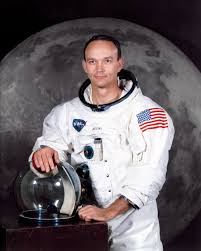
General Michael Collins (born October 31, 1930) is an American former astronaut, test pilot, and retired Major General in the United States Air Force Reserves. Selected as part of the third group of fourteen astronauts in 1963, he flew into space twice. His first spaceflight was on Gemini 10, in which he and Command Pilot John Young performed orbital rendezvous with two different spacecraft and undertook two extravehicular activities (EVAs, also known as spacewalks). His second spaceflight was as the command module Pilot for Apollo 11. While he stayed in orbit around the Moon, Neil Armstrong and Buzz Aldrin left in the Apollo Lunar Module to make the first crewed landing on its surface.
Collins is one of 24 people to have flown to the Moon, which he orbited 30 times. He was the seventeenth American in space, the fourth person (and third American) to perform a spacewalk, the first person to have performed more than one spacewalk, and, after Young, who flew the command module on Apollo 10, the second person to orbit the Moon alone.
Military Career: Prior to becoming an astronaut, he graduated from the United States Military Academy, and from there he joined the United States Air Force and flew F-86 Sabre fighters at Chambley-Bussieres Air Base. He was accepted into the U.S. Air Force Experimental Flight Test Pilot School at Edwards Air Force Base in 1960.
Collins commenced basic flight training in the T-6 Texan at Columbus Air Force Base in Columbus, Mississippi, in August 1952, then moved on to San Marcos Air Force Base in Texas to learn instrument and formation flying, and finally to James Connally Air Force Base in Waco, Texas, for training in jet aircraft. Flying came easily to him, and unlike many of his colleagues, he had little fear of failure. He was awarded his wings on completion of the course at Waco, and in September 1953, he was chosen for advanced day-fighter training at Nellis Air Force Base, Nevada, flying F-86 Sabres. The training was dangerous; eleven people were killed during accidents in the 22 weeks he was there.
This was followed by an assignment in January 1954 to the 21st Fighter-Bomber Wing at George Air Force Base, California, where he learned ground attack and nuclear weapons delivery techniques in the F-86. He moved with the 21st when it was relocated to Chaumont-Semoutiers Air Base, France, in December 1954. He won first prize in a 1956 gunnery competition. During a NATO exercise that summer, he was forced to eject from an F-86 after a fire started aft of the cockpit.
After Collins returned to the United States in late 1957, he attended an aircraft maintenance officer course at Chanute Air Force Base, Illinois. He would later describe this school as "dismal" in his autobiography; he found the classwork boring, flying time scarce, and the equipment outdated. Upon completing the course, he commanded a Mobile Training Detachment (MTD) and traveled to air bases around the world. The detachment trained mechanics on the servicing of new aircraft, and pilots how to fly them. He later commanded a Field Training Detachment (FTD), which was a similar kind of unit, except that the students traveled to him.