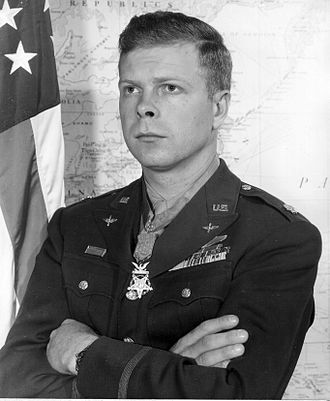

Richard Bong enlisted in the Army Air Corps Aviation Cadet Program in 1941 after finishing two years of college. Bong completed his basic flight training at the Rankin Aeronautical Academy near Tulare, California, Gardner Field, near Taft, California, and Luke Field near Phoenix, Arizona. He was commissioned as a 2nd Lieutenant for the Army Air Forces Reserve and earned his pilot wings in 1942. Bong's first assignment was to the 49th Fighter Squadron (FS), 14th Fighter Group (FG) at Hamilton Field, California, where he learned to fly the US's newest fighter plane, the Lockheed P-38 Lightning with twin engines. Due to some behavior issues (flying low through town, looping the Golden Gate Bridge), Bong was grounded (not allowed to fly). He was still grounded when his squadron was sent to England in July 1942, so Bong was transferred to the 84th FS, 78th FG. However, it was not much later before the 84th FS, including Bong, was sent to the Southwest Pacific Area (Philippines, Australia, Dutch East Indies). In September 1942, Bong was reassigned to the 9th FS, 49th FG, which was based in Darwin, Australia. While waiting for more planes, specifically the P-38s, Bong and a few others from the 9th were temporarily assigned to the 39th FS, 35th FG based in Port Moresby, New Guinea. Bong's first aerial fights occurred while he was attached to this squadron. During the Battle of Buna-Gona on December 27, 1942, Bong shot down his first two enemy planes and earned the Silver Star. The captain of the 39th, Thomas J. Lynch, had led a group of 12 P-38s, including Bong, against a group of 40 Japanese fighters and bombers. During the fighting, Lynch's crew downed a total of 12 enemy aircraft.
On January 7, 1943, Bong attacked a Japanese convoy bringing reinforcements to Lae, New Guinea, and shot down two of the planes guarding the convoy. The next day, Bong hit one over Lae Harbor, became an Ace (five aerial kills) and earned his first Distinguished Flying Cross Award. Bong had been a part of an escort for a bomber formation when they came upon 20 enemy fighters. Bong and seven other pilots with him were able to deal with the threat. His actions were rewarded by General Kenney, the Far East Air Force Commander, with a couple of weeks' leave.
In February 1943, Bong rejoined the 9th FS, 49th FG, after a short holiday in Australia. A month later during the Battle of Bismarck Sea, Bong shot down a Japanese plane, one of the four planes Bong would decommission in the month of March. Bong was awarded a second Silver Star (indicated by a bronze Oak Leaf Cluster pinned to the ribbon) for killing two Japanese pilots over Bismarck Sea on March 11, 1943. In April 1943, for his work during the previous month, Bong was promoted to 1st Lieutenant. A few days after his promotion, a group of 92 Japanese planes attacked the US shipping operation at Milne Bay, New Guinea. During the battle, Bong shot down a Japanese bomber, bringing his total up to ten, a double Ace. Bong also earned the Air Medal for his flying during this skirmish. Between this fight and June 1943, Bong did not shoot down any enemy planes. However, Bong was awarded a second Distinguished Flying Cross for his achievements in flight in the previous four months (February to June). Bong had participated in 50 operational flights where combat with hostile planes was expected. Bong's skillful flying and courage during escort, interception, attack, patrol, and reconnaissance missions inspired his fellow fliers.
The next Japanese plane Bong shot down was in June 1943. In late July, Bong shot down four Japanese planes over Lae, New Guinea, the most he had shot down in one battle. For these actions, Bong earned the Distinguished Service Cross. These four planes brought Bong's total up to 15, making him a triple Ace. On July 28, 1943, two days after earning triple Ace status, Bong neutralized another enemy fighter while escorting US planes to a group of Japanese ships intended for bombing. In August 1943, Bong was promoted to Captain. During October and early November, Bong shot down five more planes, and earned two (his third and fourth) Distinguished Flying Crosses, represented by two bronze Oak Leaf Clusters. The first was awarded for actions on October 29th when Bong was flying over Rabaul, New Britain, an island of Papua New Guinea. Flying with a party of 13 P-38s, the group encountered around 50 Japanese planes. Diving straight into the fracas, Bong quickly dispatched two of the enemy planes. The second was earned for the events of November 5th, once again near Rabaul, New Britain. Allied forces had landed on Bougainville Beachhead four days before and requested assistance in holding it against a Japanese cruiser force in Rabaul's Harbor. Cpt. Bong and ten other P-38s were on an escort mission to Rabaul when they crossed paths with about 15 Japanese fighters, of which Bong caused the explosion of two of the enemy planes.
In late November 1943, Bong was sent to the US for some time off and to do some public relations (PR) work. In between a long list of parades, speeches, and ceremonies, Bong had time to visit his family in Wisconsin. While in Wisconsin, he attended a homecoming event at Superior State Teachers College, where he had gone to school, and met Marjorie Vattendahl, who soon became his girlfriend. When he returned to the Pacific Theater in January 1944, Bong pasted a photo of Marjorie on his plane and named her (the plane) “Marge.” Bong also stepped into his new assignment as an assistant operations officer stationed at Headquarters V Fighter Command in New Guinea, which he got before he left for the states in November 1943. Specifically, Bong was in charge of replacement airplanes. He still flew in combat missions with his P-38 and soon reached a total of 28 enemy aircraft kills. In March 1944, Bong earned his fifth Distinguished Flying Cross while doing a two-plane reconnaissance flight over a Japanese base near Tadji, New Guinea. They observed a Japanese bomber heading east, so they adeptly shot at the plane, causing it to crash into the trees. Bong dodged around the bomber's escort planes and shot off the tail of another bomber, forcing it to plummet into the ground.
In April 1944, Bong was the first to surpass the WWI record of planes shot down in aerial fighting by a US pilot. Eddie Rickenbacker shot down 26 planes in WWI; Bong had shot down 28 planes. At that point, the most recent planes Bong had shot down were on April 12th while flying over Hollandia, Dutch New Guinea. For his adept flying and skill in destroying three enemy fighters, Bong was awarded his sixth Distinguished Flying Cross (DFC) indicated by a silver Oak Leaf Cluster pinned to his first DFC award. For these actions, Bong was also promoted to major, and then put on leave to conduct a war bond promotion tour in 15 states, to brush up on the latest gunnery tactics, and to visit various training bases to impart his wisdom. Bong returned to New Guinea in September 1944 and was assigned to V Fighter Command staff as the advanced gunnery instructor. Major Bong was no longer required to go on combat missions. Although he was encouraged to go on missions to observe his students, he was not allowed to seek out combat. Despite this, Bong shot down 12 more planes during the 30 combat missions he flew before the end of 1944, bringing his total up to 40 enemy planes. In these last four months of 1944, Bong flew in missions that provided air support over the Island of Borneo and the Philippines.
On October 10, 1944, Bong was part of the attack on Japanese oil refineries in Balikpapan, Borneo, where he shot down two enemy planes. With the invasion of Leyte Island of the Philippines, air support was brought in, including the 9th FS, Bong's previous squadron before he was assigned to the command headquarters. Bong joined them on the flight over from the island of Morotai to Tacloban, Leyte Island on the 27th of October, 1944. While Bong was assisting with the Battle of Leyte Island, he destroyed six more planes.
Due to Bong's choice in continuing to participate in combat missions despite not being required to, General Kenney, his commander, recommended him for the Medal of Honor. Between October 10 and November 15, 1944, Bong worked above and beyond his call of duty as an instructor by voluntarily joining flight missions where the pilots anticipated running into hostile fighters. During this period, Major Bong shot down eight Japanese planes. Bong received the Medal in December 1944 from General Douglas MacArthur.
On one of his flights in December, Bong earned his last Distinguished Flying Cross Medal. Bong was leading four P-38s on a patrol over Ormoc, Philippine Islands, and an Allied convoy area nearby when he noticed an enemy bomber. Bong gave chase, covering 3000 feet of distance before shooting up the bomber's left engine, which caused the plane to crash on Bohol Island. Returning to his observation position, Bong soon spied five more enemy aircraft. Meeting one of the planes head on, Bong quickly shot up its engine, which stopped it and led to the plane crashing into the ground. Bong picked up his last two kills on December 15 and 17, 1944, bringing his total up to 40 kills – a record that still stands today as the most planes shot down in aerial combat during WWII by a US pilot.
In December 1944, Bong was sent back to the US for good because his commander believed that over 200 aerial missions and more than 500 hours of combat was more than enough work for one pilot. When he returned, he married his girlfriend, Marge, in a February wedding. He then did some PR work by selling war bonds before being assigned to an air force base to continue his work with planes. Bong was first stationed at Wright-Patterson Air Force Base in Ohio and then Burbank, California, as a test pilot for the company Lockheed. He was testing their newest jet airplane, the Lockheed P-80 Shooting Star. While testing one of these planes in August 1945, the engine failed soon after takeoff. Too close to the ground to safely evacuate the plane, Bong died in the crash. This occurred on the same day that Hiroshima was bombed, and both headlines vied for prevalence in the next day's newspapers.
In total, Bong was awarded 15 different medals. They are the Medal of Honor, the Distinguished Service Cross, seven Distinguished Flying Crosses (one ribbon with a silver Oak Leaf Cluster and a bronze Oak Leaf Cluster), the US Army Air Forces Pilot Badge, two Silver Stars (one ribbon with a bronze Oak Leaf Cluster), 15 Air Medals (two Air Medal ribbons, one with 2 silver and 2 bronze Oak Leaf Clusters, the other with a bronze Oak Leaf Cluster), the American Defense Service Medal, the American Campaign Medal, the Asiatic-Pacific Campaign Medal w/ a silver star, the WWII Victory Medal, the Army Presidential Unit Citation w/ a bronze oak leaf cluster, the Philippine Presidential Unit Citation, the Australian Distinguished Flying Cross (British), and the Philippine Liberation Medal w/ a bronze star.
Along with these medals, Bong was honored and memorialized in various ways throughout the US. These honors include the Richard Bong State Recreation Area, formerly Bong Air Force Base in Kenosha County, Wisconsin, the Richard I. Bong Airport in Superior, Wisconsin, a squadron of the Arnold Air Society at the University of Wisconsin (formerly Superior State Teachers College), and a theater in Misawa, Japan. Bong was also inducted into the National Aviation Hall of Fame (1986) and the Wisconsin Aviation Hall of Fame (1987). Bong has many roads and bridges named after him as well, most being located on various air force bases around the country. For example, there is the Richard I. Bong Memorial Bridge along US Route 2 in Duluth, Minnesota, and Superior, Wisconsin, the Richard I. Bong Bridge in Townsville, Australia, a Bong Terrace in Mount Holly Township, NJ (built 1956-1957), Bong Street in Dayton, Ohio, leading to the National Museum of the US Air Force, one Bong Boulevard at Barksdale Air Force Base (AFB) in Bossier City, Louisiana, and five Bong Avenues located at five different air force bases. Those bases are Lackland in San Antonio Texas, Luke in Glendale, Arizona, Elmendorf in Anchorage, Alaska, Fairchild in Spokane, Washington, and Kadena in Okinawa, Japan. There is also the Richard I. Bong Veterans Historical Center in Superior, Wisconsin, formerly the Richard I. Bong WWII Heritage Center before the name was changed to include veterans of all eras. The idea was started and built by his wife, Marge Bong Drucker, and opened in 2002.
Sources Consulted:
Army Website, Medal of Honor Recipients, WWII
The National Aviation Hall of Fame
Richard I. Bong Veterans Historical Center
Air Force Historical Support Division
History Net, Aviation History Magazine
Wisconsin Aviation Hall of Fame, Inductees
Los Angeles Times, October 10, 2003
Recommended Reading:
Bong, Carl. Dear Mom: So We Have a War. Burgess Publishing, 1993.
Bong, Carl, and Mike O'Connor. Ace of Aces: the Dick Bong Story. Champlin Fighter Museum Press, 1985.
Kenney, George C. Dick Bong: America's Ace of Aces. Superior, Wisconsin: Richard I. Bong WWII Heritage Center, 2003.
Yenne, Bill. Aces High: the Heroic Saga of the Two Top-Scoring American Aces of World War II. Penguin Group, 2009.